Description
Construction
- Fixed Tube Sheet
- Floating Head
- “U” Tube
- Kettle Boilers
- Double Pipe
Manufacturing Capacity
- Shell diameter : 3000 mm
- Shell thickness : 25 mm
- Overall length : 15000 mm
- Tube sheet thickness : 250 mm
- Max pressure : 200 kg/cm2(g)
- Heat transfer area : 1 m2 to 2000 m2
- Max weight : 50 Ton
Product Description
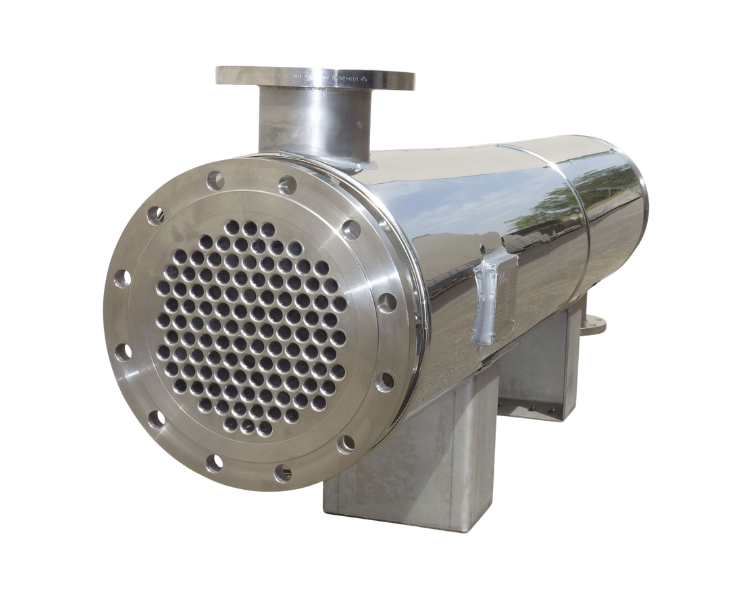
A Shell and Tube Heat Exchanger is a highly efficient heat transfer device designed to facilitate thermal exchange between two fluids while keeping them physically separated. This type of heat exchanger is widely used across industries due to its versatility, durability, and high thermal efficiency.
Key Components & Design
- Shell (Housing)
- A large, robust cylindrical vessel that encloses the tube bundle.
- Equipped with inlet and outlet ports for fluid entry and exit.
- Tube Bundle
- Composed of multiple tubes made from high thermal conductivity materials such as: Stainless Steel , Titanium,
- Hastelloy, Inconel, Monel, Nickel 200, Duplex & Super Duplex Stainless Steel, Cu-Ni Alloys
- Tubes can be arranged in different configurations such as Parallel flow, U-shaped (U- tube design), Helical configurations
- The selection of tube arrangement depends on factors such as heat transfer efficiency, flow rate, and space constraints
- Working
- The two fluids flow on opposite sides of the tube walls, creating a temperature gradient.
- Heat is transferred from the hotter fluid (process fluid) to the cooler fluid (service fluid) via conduction through the tube walls.
- The large surface area provided by the multiple tubes enhances efficient heat exchange between the fluids.
Applications & Industries
Shell and tube heat exchangers are widely used due to their high performance and adaptability. They are essential components in Power Generation, Chemical Processing, Oil Refining & Petrochemicals, HVAC & Refrigeration Systems, Pharmaceutical & Food Processing, Various Thermal & Industrial Processes
With their reliable performance, customizable design, and high heat transfer efficiency, shell and tube heat exchangers remain a preferred choice across industries for critical heat exchange applications.